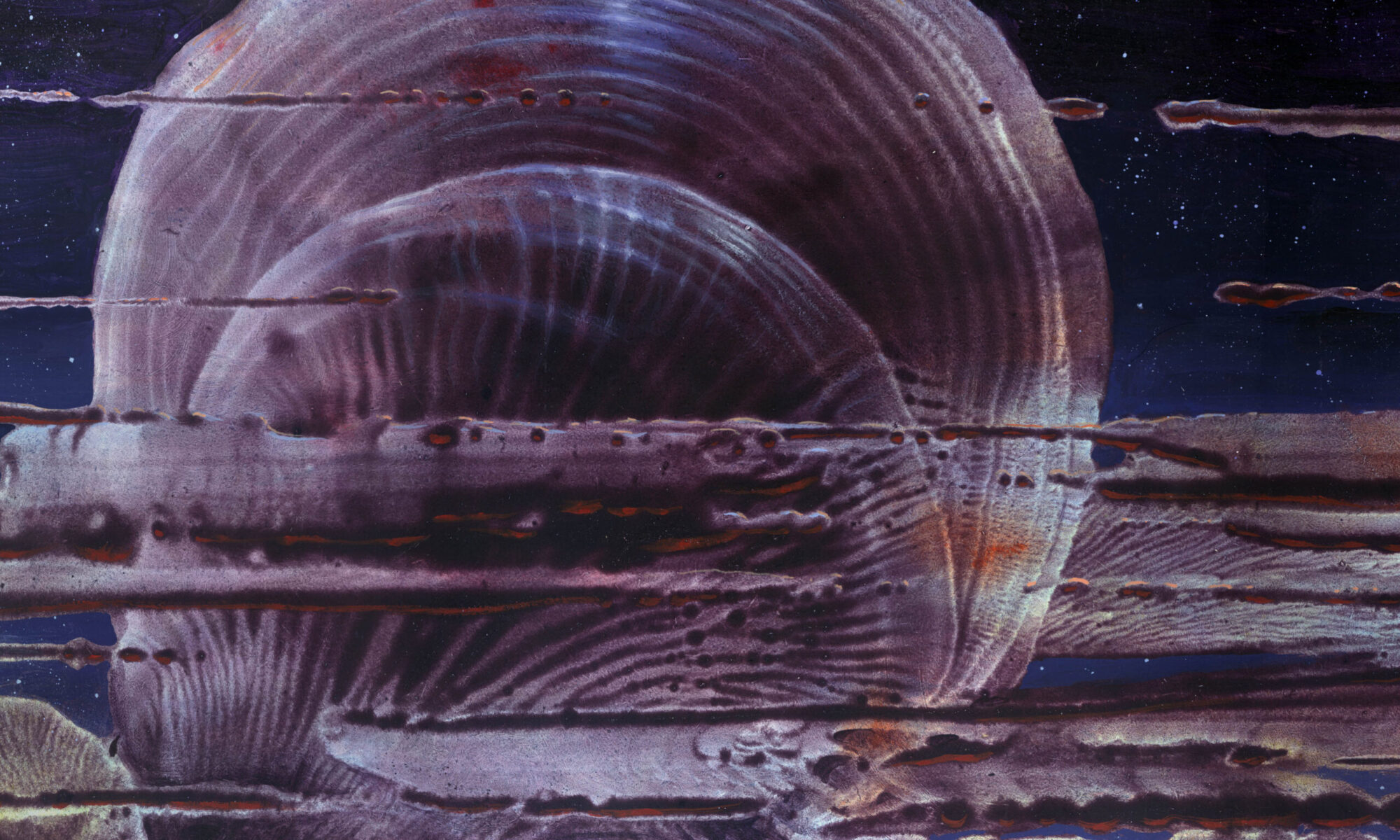
In 2005 I flew to New York to work and stay with Jill Bauman at her studio for 5 days. During that time, we completed three paintings and started a fourth.
The first painting was one we had begun when she visited me in Nashville, Tennessee in 1992. She wanted to try some of the unorthodox painting techniques I call Controlled Accidents. I often use these techniques to help me generate subject matter. We had no idea what we were going to paint when we started and intended to see what the paint might suggest to us, something like looking for images in an inkblot test. I began the painting with a dark blue-black color covering a piece of hard board. Once this was dry, I put a light gray-blue on top of it and manipulated the wet paint with an acetate cylinder. This creates fantastic shapes and textures in the paint as you roll, pivot, compress or slide the cylinder.
(A further explanation of various Controlled Accidents techniques will appear below.)
We discovered within the paint subject matter we both wanted to develop and began to work, but ran out of time. We didn’t find time to finish “Locked in the Angel Closet” in 1992 and didn’t complete it until thirteen years later in 2005.

"Locked in the Angel Closet"
Our second painting was begun with a piece of hard board gessoed bright white, then stained with pastel color. When this was dry we put various rich blues and purples as well as muted darks on the surface and while they were wet manipulated them with one of those balloons you blow up and twist into animal shapes. Once again, we looked for and found and agreed on our subject matter and developed it. This painting we titled, “World of Waters Wild.”

"World of Waters Wild"
Our third painting was on canvas. We started by staining the bright white surface with rich bright reds, oranges and yellows. Then we put dark, muted green and brown on top and while it was wet, pressed wrinkled cotton rags into it. Where ever the rag touched, the paint was lifted off in varying amounts, where ever there was a wrinkle, the paint was left behind. This provides very rough, rocky shapes. In the paint, we discovered and developed the painting, “The Fall of Calculus.”

"The Fall of Calculus"
Jill had not ever collaborated before working with me. At the beginning of piece, after the controlled accident had been developed and we were looking for subject matter, she asked to know what my intentions were for the paintings—not just what I saw and might want to bring out of the spontaneously generated images, but what my vision was for each painting. I told her that it wouldn’t be a collaboration if I dictated these things, so we should develop the work together, discussing what we saw in the paint. I said my only intention was to come up with a reasonable composition.
Each time, after her initial reaction, she would relax and the work would proceed.
Afterward we discussed this and she seemed to find it all a little frightening, but an exciting process of discovery. Each painting, it seemed to have become easier for her.
I am very proud of the work we produced.
Below I’ve provided two excerpts from my art book, The Paint in My Blood. The first covers some of my views on collaboration. The second helps explain the spontaneous techniques we used to develop subject matter for the paintings.
(The following is excerpted from the chapter WORKING AND PLAYING WITH OTHERS)
From my experience there is no better situation for learning than collaboration, being involved in another artist’s work in progress and discussing the process. I have collaborated with other artists in photography, painting and drawing—both fine art and illustration—mixed media, sculpture, writing—short-shorts, short stories and novels—book design, book proposals, radio plays, and interactive CD-ROM.
Since each collaboration is unique, it is not easy to express the value in the difficulties, excitement, laughter, and camaraderie between artists. I can say that what draws me time and again are some of the same things I look for in producing my own artwork: The thrill of discovery, a powerful learning experience and the production of a unique and experimental piece of art.
When collaborating with another artist, whether he or she is a writer, visual artist, sculptor, or whatever, a new artist emerges, one who has the strengths we each possess respectively, but also is less encumbered by our respective weaknesses.
I try to approach collaboration with the view that no idea of mine is too dear to be tossed out. The best results come when my collaborator has this same humility (teachability). But even if our efforts fail, I have gained from the experience.
(The following is excerpted from the chapter EXPLORATION, EXHUMATION AND A SENSE OF WONDER)
I discover a portion of nearly everything I paint while producing it. I pack the process of developing an illustration with as much opportunity for discovery as I can. While working up an idea, I distract myself to promote free association and automatism. I scribble when sketching and explore any line that suggests a new and interesting direction. In painting I use what I call “controlled accidents” and “forced hallucination.”
“Controlled accidents” is my term for spontaneous image generating techniques I use to help me discover subject matter. They involve pushing paint around on my painting surface—usually a smooth primed hardboard—with all kinds of odd thing such as rags, plastic sheeting, tin foil, stiff acetate, rollers and stiff boards—I even blow the paint around on a surface with my vacuum cleaner hose on exhaust. The results are suggestions of texture, shapes and contrasts—at times almost photographic in their range of values.
Artists have explored “found imagery” throughout history. Da Vinci referred to the discovery of pictures in a stained surface. Toward this goal, the surrealists developed such techniques as parsemage, which used ground pastels or charcoal and water to stain a surface, sfumage, a candle flame used to apply carbon to paper in suggestive ghostly shapes, and decalcomania, the bending and warping of images in wet paint as they are transferred from one surface to another. Rorschach ink blots are a well known decalcomania technique.
“Forced hallucination” is my term for finding potential subject matter within the intriguing, but often nondescript images generated by unorthodox painting methods. Just as one might see faces in wood grain or animal shapes in clouds and rock formations, I find images in the paint. I think of it as something like an archeological dig: There are vague outlines of structures covered in jungle or just buried beneath desert sands, waiting to be unearthed. It is exciting.
Using highlights and shadows, and adding color where needed, I bring what I see to life on my painting surface. First I see it, then I capitalize on it, and finally homogenize it into a composition. The parts of the controlled accident that do not work are replaced with contrived material. This is where the “found imagery,” which is essentially meaningless on its own, is given context. The forced hallucination is often so elaborate that I must be accomplished enough with the use of my imagination and my brush techniques to match its rich detail.
There are times when an entire painting is generated using these techniques. Other times I might start with a sketch, but large parts of the whole are undeveloped. I have some idea what controlled accident techniques to use to complete the composition in those areas, but I do not know in advance just exactly what the results will be.
Whether I am using these techniques to help develop a focal point or create middle or background subject matter for my painting, the process brings into my work the element of chance, an aspect that I would be hard pressed to achieve by careful planning. The unpredictable element of chance in the world, in life, is what keeps me fascinated. The excitement of discovery in this painting process spurs me to experiment again and again and to continually produce new work.
Having a good rapport with an art director is very important, especially when working in this way on assignment from a publisher. The client must understand the spontaneous nature of the process and be somewhat flexible. Conversely, I must be willing to start over if the results do not work for the publisher. In the end, I must be willing to set all this aside and be very predictable if that is what my client needs. The majority, however, hire me because they like my vision. How I arrive at it is up to me.
—Alan M. Clark
Eugene, Oregon