The soon-to-be occupant of the house arrives before nightfall. Through his laudanum distorted vision, he sees shadows that stretch and bend at unlikely angles in the dimming sunlight. The one he casts seems to reach eastward toward the benighted horizon, as if that one part of him might yet escape. He lingers at the edge of the footway, giving his shadow every opportunity to succeed where he, himself, has failed. One of the two women flanking him prompts him to move forward almost immediately. His silent, darkling companion gives up on escape and dutifully follows. Unperturbed, the man turns and faces what he believes will be his final destination.
The house stands two stories high and is noticeably crooked. An old neighborhood, many of the homes, especially those with overhanging upper floors, are bent or sagging. Wooden bracing between some of the houses helps keep them upright. Neighboring structures on two sides lean toward the house as if to discourage it from moving in a northwesterly direction. Dim, flickering light beckons from each of the house’s three south-facing windows, one on the first floor and two above, all of them curtained to discourage curious neighbors or other, wandering eyes. The man directs his impassive gaze to the second story windows. Their curtains are as dull and gray as the eyes he’s fixed upon them.
What is meant to be a place of respite and wellness is destined to become a prison and grave. And worse. The man’s first inkling of what is to come occurs as his charges pull him toward the stairs running down from the right-hand side of the structure to the servants’ entrance.
Gait unsteady, he descends the stairs, supported by the women to his left. Below ground level, he faces one entrance to the area and two small windows. The other woman has struck a match and lit a lamp. She turns a key in the lock and opens the door.
Before entering, as though checking to see if he has truly arrived at this moment, the man reaches up to his face, running one hand through his lion’s-mane of hair, while the other tugs at his uneven beard. Both are thick and dark and wild.
Wild like him.
Wild like a rabid cur—so his nurse will say of him. She is but the first of what will seem an endless parade of women charged with feeding, bathing, and otherwise keeping the occupant of the house sedated and confined to a room on the second floor.
Wild like the rumors about the house ignited by those who pass close enough to hear the occupant’s pained cries. Like a recurring fever, that gossip will burn quietly through Wapping for decades.
The laudanum has blunted his desire to turn and flee and taken all the fight out of him.
He takes a deep breath, lets it out, and enters the house.
~ ~ ~
The room on the second floor is uniquely crafted, though its contents are largely unremarkable. A bed, comfortable but not elegant, is positioned beside the north wall. A candle and a bible rest atop a small bedstead equipped with a single drawer. Inside the drawer are several fragments of charred wood and a dozen leaves of paper. Inside the Bible are a dozen more leaves of paper upon which the occupant has drawn the figures of a dozen undressed men, each in a different, provocative position.
An east-facing window peers down onto the street. The window is barred, and each of the four walls, the ceiling, and the floor are covered with a thick layer of quilted canvas padding. Even the door is insulated, except for a narrow slot at the bottom through which food and drink are passed thrice daily, and a smooth metal plate that occupies the space where a door knob and latch keyhole ought to be.
The occupant spends his time accomplishing little to nothing. Today, he worries at his teeth, which seem to him pointlessly square.
Later he sits before the door to his padded cell, lips moving imperceptibly as he utters for himself:
“I am Sir Geoffrey Webb. I am not mad.
“I am Geoffrey Webb. I am not mad, and this body is mine.
“I am Mr. Webb. I am not mad. You shall have no further say.
“I am Geoffrey. I am not mad, and I will not allow you to bite her.…”
Chapter2—Rollo
Wapping, London
1897
Samuel Sutton—Sam, as we called him—saved my life when he were just eight years old. At the time, he had no cause to help me, as I were doing my wicked best to give him a nobbling.
A small kid, Sam suffered the worst of our neighborhood in Wapping. We all picked on him. He were the son of Margaret Sutton, a woman of the neighborhood that many shunned and some thought to be in league with the devil.
I don’t remember how it started, but me and my mates, Zeb and Gillan, had Sam cornered in a dead end alley off Brewhouse Lane—brick and mortar and no way out. I would show everyone what a bludger I could be. I’d’ve been ten, a snotter guttersnipe with rampsman dreams.
“Give him a proper do-down, Rollo,” Gillan shouted, and I struck Sam a blow to the bonebox.
“I don’t want to fight,” he said, staggering back and coming up against the bricks.
That were laughable—we all had to fight.
I gave Sam’s smeller a blow what made it bleed.
My mates cheered.
Wiping his nose and seeing the blood come away on his hand, his face twisted into a mask so vicious, if I hadn’t seen it happen, I shouldn’t have recognized him. Then the bricky little squeaker flung himself at me and landed a blow to my gut, one what shouldn’t have hurt as much as it did. But I’d been aching there for a few days. I fell to the wet stones, holding myself against the pain. I also held my cries to keep from embarrassing myself more than I already had done.
Gillan and Zeb, the cowards, had backed off, as if Sam, small as he were, had bested me and they’d suddenly grown afraid of him.
Sam’s face lost its scowl. He looked me over with a thoughtful, troubled gaze, knelt beside me, and asked in a weary voice, “Where does it hurt?”
I tried to shrug him off and get up. A stabbing pain, what got worse as I moved, forced me to become still.
While I lay on the paving stones, he slowly pushed his stiffened fingers into the right side of my gut—uncomfortable without hurting much.
Then he pulled his fingers away quickly. That brought the pain to a sharp point, and I hashed my last meal all over us.
“Appendicitis,” Sam said, wiping hash from his face. He looked to Zeb and Gillan. “Help me carry him to Mum’s surgery.”
They hauled me to Margaret Sutton’s house in Globe Street, where she most often earned helping women end their quickening. I don’t remember much about what happened until I awoke on a cot in an odd room with a stitched up hole in my gut. The drugs she’d given me before the surgery left me somewhat addled.
Margaret Sutton sat in a chair beside my cot. “I’m quite the seamstress,” she said as I inspected the wound.
I’d been patched and sewn up enough in my life to know by the look of it that she had done a good job. “Thank you.”
I grew uneasy with her watching me without speaking. To escape her scrutiny, I looked around.
The walls were quilted canvas, with drawings of doors and the parts of doors on the cloth. Some of the quilt stuffing hung from tears in the canvas. The true door, missing the knob on the inside, stood slightly ajar.
“Whilst you likely will not feel up to it for a while,” she said, “I must ask you not to wander through the house. I am ministering to others here and I don’t want you to startle them.”
“What do I owe?” I asked.
“I will have to think about that,” she said, “since I know you have no steady way to earn.”
“Why are the walls like that?”
“Not that it’s yours to know, but long ago, a member of my husband’s family was kept here, an uncle named Geoffrey Webb. The man was quite mad.”
A vaguely familiar name, even if I couldn’t place it.
“Given the chance,” she added, “he might have hurt himself or others.”
Then Margaret dropped her serious tone and spoke to me almost as if to a friend. From what I knew of her, I’d say she had no friends. Her son spent more time on the street than at home. Sam did that even though he had to go up against guys like me and my mates who gave him nothing but grief. In that moment I pitied Margaret.
“Geoffrey had been knighted,” she said.
“Oh, a war hero?”
“No, nothing like that,” she said with a scoffing chuckle. “He was knighted for his charitable work. Otherwise, when he started causing trouble, he’d have been locked away in an asylum to rot.”
“What trouble?”
“Indiscretions with young men and later some violence as well. I don’t know of what sort. I think that was merely an excuse to put away a man who had become a family embarrassment. Instead of an asylum, the family put him here and kept him here for many years. In that time, he did the drawings on the walls. The padding helped keep him from hurting himself.”
“Where is he now?”
“I believe he died in 1853. The house stood empty until I opened my surgery here in 1883.”
Margaret stood to leave and said in her normal, too-serious voice, “Behave yourself and maybe I’ll show you how they kept him from hurting his minders.”
Something about her manner in that moment put a fear in me. Her slight smile had no charity or humor, as she turned away and left the room, pushing the door almost shut.
I knew I had forgot to be frightened of her. Or maybe the drugs she used on me had finally worn off and I could think again.
Everyone knew the rumors of Sam’s mum being a witch. They had been around since before I came along. I imagined her returning with straps to lash me to the bed or a surgeon’s knife to cut off my arms. I hadn’t been so afraid since I were a small child.
And the name Geoffrey Webb stuck in my head, as if by speaking his name, Margaret had awakened the mysterious knight, himself, and he meant to pass on to me whatever madness he’d once suffered. I found myself repeating his name silently over and over. Days passed before I shook the habit.
As I healed up, Margaret checked on me now and then, often very chatty, as though she were lonely. What could she get from a conversation with the likes of me? I kept thinking she wanted something from me she didn’t have the words to ask for.
The remainder of my stay, I worried what she might bring through that knobless door. Turned out, I had unfounded fears.
One day, she brought in a German game, Stern-Halma, with marbles on a board. While we played, she talked about Sam. The way she spoke of him, I didn’t think she cared for him much, which left me unable to account for her next words: “Should you persuade him to come home, I’d consider your account square.”
I might have been indebted to Margaret Sutton, but I owed Sam my life. If he’d decided to run away from home, I wouldn’t get in his way. “He would not deem that any of my business,” I told her.
Margaret Sutton looked at me, vexed. “Errands, then,” she said, and stood. “Yes, my very own loblolly boy.”
I didn’t question her, though I knew that to be a type of ship’s boy, one attached to the surgeon. She helped me to stand and showed me the door.
The debt to his mum aside, I would not forget Sam’s kindness in the midst of my cruelty. Thereafter, I did my best to repay him with friendship.
The Paris that the Surrealists saw after WW I was not free, cheerful, and gay. It was grim. F. Scot Fitzgerald tried to romanticize Paris in the 1920s but it smelled like a slaughterhouse. Fitz lied to please the aesthetes of his day. As the early surreal paints—Max Ernst, Andre Breton, Salvador Dali, Yves Tanguy, Joan Miro, Rene Magritte, Hans Arp—wended their way to the local wine cafe, their eyes were assaulted by the wreckage of men and women and children who were maimed over the treasures of culture. Countries fought as much over culture as over geographical territory, over terms—buzz words—like the German term ‘Kulturkampf’ or ‘guerre culturrel’ in French.
In peace time nations had to be content with simply censoring each other’s language, music, art, and literature, but in war, these nations could blow up everything, as well, leading to that famous sentence from a later war, “We had to destroy the village in order to save it.”
These returning artists, coming back from the front, saw that they were repeating themselves, their minds running in the rigid ruts of what we now call PTSD (post-traumatic stress syndrome), so they did everything possible and IMpossible to not celebrate the cultures and the norms and the histories of society, art styles, that had led to the series of wars upon wars. This was the first time an art movement was founded upon ART THERAPY.
A few latched onto Freud, such as Salvador Dali. the Belgian painter Magritte latched onto the linguistic approach of Ferdinand Saussure–that the words in a nation’s language had no “sacred” connection to the thing symbolize. Magritte’s famous painting “La Trahison des images—Ceci n’est pas une pipe” or in English “The Treachery of Images—This is not a pipe” tried to break the magic of national feelings about language. If we were to realize that the lovely words each language has for things are arbitrary as much as pulling words from a hat, then perhaps one less thing to have wars over, oui? How many who see this painting online or in its original at the LA County Art Museum recognize its origin in PTSD and post-war art therapy? (Be honest.)
Few countries will have wars over “ready mades,” either like DuChamp’s Urinal installation, (until that urinal gets “monetizes.”)
The Surrealist term “aleatory” was used for their scientific and artistic experiments with chance patterns. One surreal “readymade” poetry technique was to throw words into a hat and make poems of what came out. Or paint the mysterious image of dreams if not too PTSD. Then Max Ernst hit upon another aleatory technique: Decalcomania. This is the same root word for commercial decals (pictures with sticky basks) that are stuck upon objects. But artists loads a sheet of glass with paint and list it off quickly so that random rivulets formed. They worked into the accidental shapes. See any online collection of Max Ernst’s art. A noted science fiction and horror magazine illustrator, Alan M. Clark is a skilled decalcomania painter. I was fortunate to view Alan’s demonstrate of the techniques in Sept. 2022. Since then I have been making a series of decalcomania paintings.
Hope you like these paintings released today to honor the Surrealists and their struggles.
Oh wow did this book bring back memories of being a kid growing up during the 1960s and 1970s! The main character, Lucy, has a few years on me, though. And a much weirder childhood with more complicated family dynamics and unusual goings-on. Many of which are not just unusual, but seem downright supernatural.
When you’re a little kid, especially a little girl, the world can feel like one big puzzle with everyone keeping secrets, withholding information, and saying you’re not old enough or you’ll understand some day. They expect you to be quiet and obedient and follow the rules.
But, when you’re a curious, clever, rebellious, stubborn, sassy, tomboyish little girl, “some day” isn’t good enough, and Lucy understandably chafes under being kept in the dark and having her questions go unanswered.
Why, for instance, does her grandmother have so many strange rules no one else in the family seems to have to follow? Rules about opening windows, and taking naps under the bed? Why does her grandmother bury glass jars containing odd items in the garden? Why do her grandmother and the family housekeeper, both practitioners of rustic magic, have such a strained relationship?
And what about the other girl — ghost-girl? — Lucy keeps seeing? What about the man in the dark suit and black fedora? What’s up with the crowds of crows, and why does it upset her mother so much? What’s going on with her brother? With the new neighbors who move in, the ones with the peculiar daughter and the pet monkey?
Having the story unfold presented through Lucy’s childlike point of view lends it that genuine feeling of being simultaneously aware and unaware of the greater moving currents all around you, the frustration of being left out and no one will let you in. Really well-written and evocative, it makes for an engrossing read, as Lucy continues to push the stifling boundaries imposed upon her.
My only complaint, or maybe disappointment, was the ending, which felt kind of abrupt and left a lot of tantalizing questions unanswered. Yet, even that, given the themes of frustration and not-knowing Lucy has to deal with throughout the book, is somehow fitting.
I was asked to write a post about one of my novels for Shepherd.com, an innovative new site for books and authors, whose tag line is “Discover the Best Books.”
I suggested that I write one with Lisa Snellings about our collaborative novel, Night Birds. Here’s the description of the novel:
In Night Birds, Lucy's grandmother, Annie Maude, may be a witch, her school's lunch lady might be a murderer, and a mysterious figure stalks her in the small South Carolina town where she lives. The chapters consider themes of mental illness, religion, sexual orientation, witchcraft, and death as seen through the eyes of this plucky girl growing up in a haunted house in the 1960's. Charming, provocative, funny, and creepy as Hell, Night Birds will shake you up before leaving you all warm and fuzzy inside.
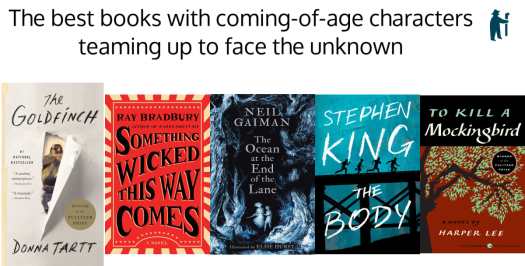
The suggestion approved by Shepherd.com, we received a template to fill out. It included questions about us, the novel, and what five books by other authors were our favorites that might fall within a similar category. We were asked to give that category a name that would become the title of our post. That title had to begin with “The best books…” The image below shows the title we chose and the five books we selected.
We were asked to write about our personal experience of reading those books. Here’s the one we wrote about The Body by Stephen King:
The Body is Gordie’s odyssey into imagination. As we would be inclined to do, he wants to see the dead boy out of morbid curiosity. He also wants to be the hero who found the body. The odyssey tests and reveals Gordie’s character and that of his three friends. As with the boys, we bear some lonely disappointments and pains. We’d be going to see the dead body merely so we could think to ourselves, at least that’s not me. Perhaps that’s what motivates them too. Who doesn’t do that? Yet their quest doesn’t lead only to an unknown dead boy, but to the dead boy in all of them, perhaps all of us. They are brought together as one by the experience and win the prize—they are alive.
This was a fun process for us and I would recommend it to other authors as a way to help audiences find books they like.
Carolina grew up in a lazy town in Newbridge, Ireland. She has loved reading, writing and books for as long as she can remember. As a toddler, she loved reciting poems. At the age of two, Carolina and her mammy made a habit of visiting the local sweet shop, where the lady at the counter would write poems on scraps of paper and give them to Carolina to learn, and if she did, she’d get sweets. Carolina’s love for learning (and getting sweets), led her to develop her narrating skills from a young age.
After obtaining her Bachelor’ degree in English Literature, she decided to take a Masterclass with Dan O’Day and David H. Lawrence XVII. Carolina is now narrating books that require an Irish accent, and she is also writing her second fantasy novel. Carolina teaches English to foreign students to help pay the bills.
Cover for the audio book of FALLEN GIANTS OF THE POINTS, by Alan M. Clark, read by Carolina Cioara
First of all, I chose Carolina Cioara as narrator because she caught the emotion behind the words I’d put on the page, her vocal inflections capable of expressing them appropriately when they were subtle, overt, or extreme. She reads at a nice pace for listening, and she is easy to work with.
I chose her also for reasons having to do with characters in the novel. Fallen Giants of the Points opens with an “Introductory Note from the Authors.” The “authors” in this case are the two fictional main characters, Alta Mae and Cedric Brewer. The note conveys that the story that follows is an autobiographical account, written by the characters in adulthood of their experiences as children.
Many of those who immigrated to the city in that time, no matter where they came from, ended up on the streets, destitute, jobless, and homeless. Those able to find jobs, in many cases, found themselves over-worked and abused by their employers and landlords. Desperation among these unfortunate human beings frequently led to criminal behavior, and drug and alcohol abuse. Disease more easily claimed the lives of those suffering such hardship.
Children in these situations often fled to the streets to get away from abusive home life or found themselves orphaned and homeless upon the death of their parents. The numbers of orphans increased well beyond the city’s capacity to manage. Some of the children were rounded up and sold into the service of those needing child labor. Others survived as best they could, avoiding the “coppers” and those who would capitalize on their labor.
During much of the first decade of their lives, Alta Mae and Cedric Brewer are homeless orphans on the streets of Manhattan during the 1840s. They spend much of that time free, if hungry and suffering from exposure to cruel weather, especially in winter. They do not possess memories of their parents.
At the time, New York City had immigrants mostly from northern Europe and what’s now known as the UK. The big waves of immigrants from eastern and southern Europe had not occurred yet, so the accents of those learning to speak the main language of the city, English, would have been most heavily influence by the English, Scottish, and Irish who immigrated to the city or were engaged in maritime trade there. Most of the slang of the time, including the thieves cant of the streets, comes from England. Additional significant influence on the language would have come from escaped black slaves fleeing from the South to the North. During the Irish Potato Famine (1845 to 1852), innumerable Irish came to New York City to escape hardship—more like out of the frying pan, into the fire. Many made the passage as indentured servants, then fled their masters upon arrival and hid among the countless homeless on the city’s streets, especially in the neighborhoods around Five Points, in lower Manhattan, areas so dangerous and crime-ridden, the police would not patrol them. This was the neighborhood in which Alta Mae and Cedric spend their early childhood.
Thinking about the voices of Alta Mae and Cedric Brewer, I decided that they most likely would have a light Irish accent. I also wanted that voice to sound young since, in most of the tale they tell, the characters are between the ages of five and eleven years.
Listening to Carolina Cioara read the sample I provided for auditions, I could clearly hear the characters speaking. She also proved herself quite capable of delivering the slang in the novel, mostly thieves cant, quite naturally.
I highly recommend the experience of listening to the adventure tale, Fallen Giants of the Points, as read by Carolina Cioara.
—Alan M. Clark
Eugene, Oregon
The audio book of the novel, FALLEN GIANTS OF THE POINTS, by Alan M. Clark, read by Carolina Cioara, is available from Audible.com and other online retailers such as Amazon.
Lucy’s grandmother may be a witch, her school’s lunch lady might be a murderer, and a mysterious figure stalks her in the small South Carolina town where she lives. The chapters explore themes of mental illness, religion, sexual orientation, witchcraft, and death through the eyes of this plucky girl growing up in a haunted house in the 1960’s. Charming, provocative, funny, and creepy as Hell, Night Birds will shake you up before leaving you all warm and fuzzy inside.
First Chapter of Night Birds
1—The Blimp
1963
Daddy called me Rooster, since most mornings he found me awake when he arose. I was a bird, but not that one. No, I was a night owl, up most of the dark hours watching and listening in the quiet.
I didn’t start out that way. I’d begun in life sleeping soundly.
What troubled my sleep started with the steam whistle at the cotton mill where my father worked. Normally it blew at shift changes, 8AM and 4PM. If the whistle sounded any other time, folks sat up and took notice, because that meant something terrible had happened.
The mill had a long history of terrible things happening. The worst stories that went around town had always been about accidents at the mill. Of course they grew more dreadful still as the tales passed from one child to another on the playground, around campfires, and under the bleachers at little league games.
The first time I truly noticed the whistle, I was five and knew nothing of these legends. The moment the sound startled me, a big shadow crept over my backyard and I looked up. A blimp, I would later learn, but in that moment the shadow belonged to a silver monster in the sky, and the whistle had been its scream. As the thing drew closer, I heard an ominous droning. I scrambled for cover under my porch. The drone got louder, then changed pitch, moving off into the distance.
I saw movement in the corner of my eye, something pale among the short brick columns supporting the house. A girl, about my size. She wore a pink sack, more like a nightgown than a dress. What was she doing under my house? Maybe she was playing, and I could join in. She stared at me with big, dark eyes in the palest face I’d ever seen.
“Little girl,” I called out, and made my way on hands and knees between the columns through the sand, sticks, and leaves that had been blown under the house. My knee pressed down on something sharp and I stopped to look. A toy car, one of my brother’s, I guessed.
When I looked back up, I could not see the girl. Searching for her, I crawled forward, calling out “Hello? Little girl?”
I heard my parents’ muffled voices and crawled to a spot directly under the kitchen where, once before, I’d listened to a conversation between Mama and Ruth, the woman hired to help around the house.
“I hate that sound,” I heard Mama say sharply. “I nearly jump out of my skin every time it blows.”
I thought she meant the silver monster’s scream, and wondered if she’d become frightened like I had.
“Hate it all you want,” Daddy said, “but I’m the one who has to go down there. Whatever has happened is not going to be pretty.”
He wasn’t afraid! His footsteps crossed the floor to the door, then the back porch, and crunched into the drive as he hurried to his car. Maybe he would go scare the monster away. Dust from his hasty departure blew under the house, choking me. I had to get out of there.
I’d forgotten all about the strange girl.
Inside the house, I found Mama staring out the kitchen window. She had a troubled look, standing with her hands tightly gripping her elbows.
“What’s wrong, Mama?”
She started, rubbed her hands hard against her apron.
“Is Daddy gonna be okay?”
“Yes, he’ll take care of it.” she said, her voice sounding far away. “Go wash your hands for lunch.”
Just to see her in such a swivet, I knew I should be troubled, but I also knew Daddy would fix everything. He always did.
Standing at the bathroom sink, I rolled the soap in my hands and thought about the little girl under the house. Though she sure looked strange, I’d be looking for her to play with first chance.
When Daddy came home and we sat for dinner, I asked him about the screaming sky monster.
“Is that a cartoon?” he asked.
“No, It’s in the sky.”
“Oh, an airplane,” he said.
Mama laughed, said, “You have quite an imagination, and kissed me on the head.
Mama had smiled at me, so I knew she wasn’t afraid anymore.
All seemed right with the world again.
~ ~ ~
Some weeks later, at Mrs. Eunice Cleary’s house, I sat in the waiting room while she finished giving a piano lesson to the student ahead of me. I winced at each sour note while thumbing through a comic book that became more frightening with each new page. I’d picked it because I knew the Archie ones by heart, and had found all the hidden objects in the one copy of Highlights. Turning the page, I discovered a picture of a woman on a bed, her mouth wide in a terrified scream, as snakes slithered out from between her legs. I wadded the comic book up and shoved it under the couch cushion. Wiping my hands on my shorts, I did my best to forget what I’d seen. Somehow I knew I wasn’t meant to see that, and had to wonder how it had gotten there. I didn’t look at the student leaving, embarrassed at the thought that he might know what I’d seen.
My turn to enter the music room. Mrs. Cleary sat in her chair the same as always, but she hunched oddly, as if shrinking into its cushions. Red rimmed her eyes. The room smelled sweetly of oranges. She set down the orange she’d been peeling when I entered and wiped her hands on a napkin alongside a bowl of peels. Another bowl held several oranges. Someone had eaten a lot of the fruit. Mrs. Eunice blew her runny nose into her napkin.
“Would you like one, dear?” she asked.
“No ma’am,” I said, “I’ll get sticky on your piano.”
“Of course,” she said, “what am I thinking?” She bent over and wept, her shoulders shaking.
I stood there not knowing what to do. Had I done something wrong? Should I have taken the orange?
She mopped at her face, sat upright with a weak smile, and patted the piano bench. “Sit down, child. Despite our heartaches, we must all carry on.”
What heartache did we suffer? I wondered. Then the thought occurred that she meant strictly her own heartache.
“Please open your book to the new lesson.”
I thumbed past the pages with gummed, gold stars on them to the new piece I’d been practicing at home.
Before I’d played a single note, the cuckoo clock’s bird called four times from out in the waiting room, followed by the scream of the silver sky monster.
Mrs. Cleary cried out, buried her face in her napkin, and started weeping again.
I looked toward the window. Though I’d heard its scream a few times, I hadn’t seen the monster or its shadow since the day I hid under the house and saw the pale girl. Hidden indoors, I felt much safer.
“Dear child,” she said. “I-I’m so sorry, but I must go lie down.”
I took her sticky hands in mine and looked her in the eye. “It’s all right,” I said, trying to calm her. “It won’t come after us. It’ll just fly on by.”
She stared at me for a moment as if I wasn’t there, then took her hands back, sniffed, and said, “You may sit in the waiting room until your father arrives.” She hurried from the room.
Left with just imagination to answer my questions, I had to wonder if the monster had come after her before, maybe chased her. I looked around the room, saw the oranges and peels, Mrs. Cleary’s discarded napkin. She’d left the door to the rest of the house open. She never allowed that. What was going on? Maybe she’d eaten too many oranges. I ate too many plums once and pooped my pants. Maybe something like that had happened and she was embarrassed.
Remembering the horrible comic, I decided I’d rather wait for Daddy on the doorstep. Outside, to my surprise, I found him leaning against our car in the drive. Seeing me, he looked at his watch, dropped his cigarette, and snuffed it out with his foot.
“Ready to go early, huh, Rooster?”
“She heard the monster and got all upset.”
He frowned, turned his eyes to Mrs. Cleary’s door and back to me. “I see.”
He opened the car door. I gave him my lesson book, slid across the seat to my side, and we started for home; away from the horrible comic, the smell of oranges, and Mrs. Cleary’s mysterious heartache. Unsettled, I huddled into myself, my knees drawn up to my chest, my hands bunched up under my chin. I would have liked to hug Daddy, but I couldn’t while he drove the car. My summer clothes felt too thin, the sun too bright.
I felt Daddy looking at me. He reached over, opened the glove box, and pulled out my Bunny, the stuffed one I’d had since before I could remember. I grabbed the toy and held it tight against me, resting my chin between its ears.
“You’ll have to forgive your piano teacher,” Daddy said, glancing at me with an earnest look, “She lost her husband a few weeks ago.”
“Lost him? Did the monster in the sky get him?”
He gave me a funny look, then shook his head, “No, Rooster, he was in an accident at the mill.”
“Will he be found?”
“No, honey, it’s not the same kind of lost. He’s passed away, gone to heaven.”
“That’s forever, right?”
“Yes, and that’s why she’s so sad.”
Not understanding, I grew quiet and nuzzled bunny tighter. The familiar smell of the stuffed animal rose up and helped ease my mind.
Daddy glanced at me once, twice, and said, “all living creatures pass away sometime.”
“To heaven?”
“Well, not quite all.”
He meant that animals would not go to heaven. We’d had a conversation about that once before, one I didn’t like.
Thinking about how Bunny would never leave me to go to heaven or anywhere else gave me comfort. Because the stuffed animal wasn’t exactly alive, it would never die.
But I could lose Bunny, accidentally leave it somewhere. Imagining Bunny lost and alone someplace dark and dreary brought back all my unease.
The little lost girl under the house sprang to mind. Had she been misplaced?
And how did I know she was lost?
(End of first chapter of Night Birds)
The novel is coming soon from IFD Publishing, and will be available in paperback and ebooks from all major online retailers
(Greydogtales has kindly allowed this blog post to appear here on The River’s Edge Blog.)
Today’s special – an extensive interview with Alan M Clark, award-winning artist and writer, on his recent novel Fallen Giants of the Points (IFD Publishing, 2021), something which should be of interest to novel writers in general, and those who use historical settings in particular.
Most readers will know Alan from his Jack the Ripper Victims series, widely praised for its focus on the real women of Whitechapel in the 1880s, where their lives, their hopes and failures, are what truly matters – not the murderer. His latest book, set some forty years before that terrible autumn and a continent away, revisits poverty and deprivation to commence a new and epic journey:
A novel inspired in part by the early gangs of New York, this sprawling adventure is also a western, a coming of age story, and a tale of redemption that carries readers from the streets of infamous Five Points, New York City in the 1840s to Gold Rush era San Francisco. Told from the point of view of two dauntless orphaned children, Alta Mae and Cedric…
It’s a rattling good read, skillfully done – we dipped in from curiosity, but found ourselves reading the whole thing through, and glad we did. So we cornered Alan and got the full story what lay behind the book – his approach, his inspirations, and his thoughts on some of the issues raised.
alan m clark
FALLEN GIANTS
greydog: Alan, welcome back to greydogtales. First of all, although we’re most familiar with your powerful late Victorian fiction set in England, Fallen Giants seems to fall within your ‘Early Americana’ body of work, one which includes The Door that Faced West and A Parliament of Crows. Both of those books were inspired by true events –Fallen Giants is, as far as we know, purely fictional, albeit rich with genuine period detail and historical themes. What inspired you to take this one on?
alan: I started out wanting to write a novel set, at least in part, in The Old Brewery in Five Points, New York City. The place has a role in Martin Scorsese’s film, The Gangs of New York, but we get mere glimpses of it, and much of its character is missing. For years, I’d been fascinated with The Old Brewery’s history as a haven for criminals and the extremely squalid nature of the place as a tenement. While the Old Brewery was a brewery, the three-story structure had been expanded with numerous additions and ended up looking like several structures jammed haphazardly together. It became a tenement some time in the 1830s.
The descriptions of the place as a tenement beggar belief—the numbers of people residing there, the debauchery, the murder rate on the premises—yet all descriptions I’ve found, though from different sources and worded differently, seem to be fairly consistent. To rid the city of the place, a charity bought it and razed it to the ground. I wouldn’t be surprised to learn they’d then sown that ground with salt to prevent another crop of criminals from growing there. If they did, it didn’t work—that part of New York City has bred some of the worst gang violence in history.
So then I had to bone up on the criminal and political gangs of the 1840s—the time period of my story—in and around Five Points. The Bowery Boys and other Protestant, nativist gangs caught my attention because their politics were so similar to that of the MAGA crowd of today: Their bigotries, their use of outrageous conspiracy theories, and just bald-faced lies to manipulate people, to divide and conquer politically. In the decades following the 1840s, their politics would go a long way toward building the Know Nothing Party, a nationalist group of some power in the late 19th century.
I discovered that members of the nativist gangs of New York joined up to fight the Mexicans in California during the Mexican-American War. The notion of Manifest Destiny had Americans enthralled in that time, and the idea of westward expansion had become so popular that the small number of Mexicans on the West Coast didn’t stand a chance of keeping the land they’d claimed as their own. Gold was discovered near the end of hostilities. When the war ended, and the New York gang members were mustered out of service, some chose to stay in California. Many Mexican civilians remained as well. Some of the white, Protestant Americans, arriving by the day along the California Trail during the Gold Rush, didn’t want to share California with the brown, Catholic, Spanish-speaking people. The Nativist Gang members who had stayed saw an opportunity in that. They formed a new gang called the Hounds, and hired themselves out to merchants and politicians as a private security force to run the Mexican’s out of the area.
With all that, I decided I’d found the historical bones of the tale I wanted to tell. Now I just had to create characters to move around in it and help me “see” the terrain of that history and the story that might unfold within it.
other americana also from alan
greydog: How did you settle on telling the tale from the point of view of two children, the girl, Alta Mae, and her younger brother, Cedric, rather than the adults?
alan: I needed characters that could represent young America herself. The orphaned children emerge from the cultural melting pot of New York City. They are innocents in a lot of ways, not worldly, but canny children of the streets with pluck. Like many orphaned children of that time, they were concerned with keeping their liberty rather than working in the service of others, either as adopted children required to labor for a household or farm, or sold through contract as labor for some industry. They engage in criminal behavior to survive on the street, but are not heartless and cruel. Many of those aspects of their characters speak to me of early Americans in general, a downtrodden and flawed but capable bunch, with strange notions about gaining and keeping their liberty, a sizable share of them with criminal backgrounds.
Photo by Jacob Riis. The photo was created in the 1880s, forty years after the timeline of the novel, and that just goes to show how little changed for homeless children in New York City over the decades.
greydog: The children are as young as five and seven when the story begins. What was it like trying to depict a child’s thinking and motivations? Presumably you were able to draw on the fact that children exposed to such harsh conditions had to develop a degree of ‘know-how’ just to survive – more than sheltered or advantaged children.
alan: Yes, I think we like and respect them because they are toughened enough by their experience growing up in Five Points to be rather fearless. That toughness was handy while considering what they’d be willing to do in dire circumstances, of which there are many in the narrative.
In writing from a child’s perspective, I try to narrow the scope of my understanding of what they encounter, as if I only have their experience to draw on. They make simpler connection in understanding than I might, ones that are often naive, or even laughable, depending on their age. In communicating with others, they more often take people literally. Here’s an exchange of dialogue that might demonstrate that last idea:
Adult: “Please accept my condolences.”
Child: Not knowing what condolences were, I thought he would hand me something. Like a goosecap, I just stood there looking at him, waiting. A moment passed before he nodded and walked away.
Since they age by several years in the course of the narrative, I had to adjust my approach to depicting them as the tale progressed, to allow for the greater understanding that they gain over time.
greydog: The chapters alternate between the point of view of Alta Mae and that of Cedric. Did this arise as a method of revealing different aspects of the overall story, or for other reasons—and were you ever tempted to add in chapters seen through the older brother Egan’s eyes?
alan:I was never tempted to add chapters from Egan’s POV. He, too, is an orphan, but several years older and not at all the innocent that his younger siblings are.
Bouncing back and forth between Alta Mae and Cedric, I could have two views of the same thing if needed, I could show differences in their personalities, and how they could be drawn together as fiercely loyal allies, or separated as enemies, at least temporarily, with a sense of betrayal. Having survived together on the streets since earliest childhood, they had naturally developed resentments toward each other. The hard feelings that come between them threaten their chances of reaching shared goals—just another bit of conflict thrown into the mix to make the drama multi-layered, and human.
greydog: The novel starts out with the children believing their parents are giants composed of animated clusters of buildings. It’s a powerful piece of imagery. What inspired that aspect, and how did you set out to make it believable?
alan:Fallen giants as those who were looked up to but have fallen from grace is a key theme explored in the novel, so why not take it literally as well, I thought.
My own weird beliefs when young told me it was plausible that children of five and seven might believe such things. And the “giants” thing was actually inspired by my own experience—I was maybe five when my grandparents took my brother and me to a baseball game. The grownups talked up how exciting it would be to see the Giants play—this was when the Giants were a New York team. I suppose I didn’t think too hard about what the Giants were like until we got to Shea Stadium and I saw the high ceilings. Then I became afraid, because I knew we were truly going to be exposed to real giants. That is a hazy memory, but an indelible one.
To make that believable in the novel, I show the conversation in which Egan presents the lie. Here it is from Cedric’s memory (abbreviated):
“Our Ma were a giant prostitute,” Egan told us. “She died shortly after giving birth to you, Cedric, and fell dead along Little Water Street. People took up inside her.”
“They lived inside her?” Alta Mae asked.
“Yes—still do—but you have to understand she were made of houses. We’ve visited her corpse many times. It now looks like houses along a dead end.” (In that day, several houses in a row under the same landlord might be considered one tenement)
“The Cow Bay tenement?” she asked, tilting her head this way and that.
“Yes.”
Alta Mae gave Egan a withering look, her lips drawn back. “She couldn’t move if she were houses.”
“Little girl,” he said with a big, loving smile, “there are more things possible than you’ve known or seen in your short life.”
She shook her head slowly, as if unsure.
Egan nodded, his face open and truthful, or so it seemed.
Alta Mae frowned, squinted at the bright sky, then nodded to show she understood.
And, so, I took his words as true.
Egan tells them that their father, also dead, was a drunkard and is the tenement known as the Old Brewery. Alta Mae struggles to understand how that’s possible and finally works it out in her head:
I remember some of how I’d found my own truth in his lie. Must have been six years old when I saw the head of a figure in each of two windows set close together in the Old Brewery’s main building. As they moved about, as if together, I thought of them as Papa’s blinkers looking out at me. Never mind he was supposed to be dead. Two sets of five privies along the North side became Papa’s toes. I pictured him wiggling them and startling folks inside doing their business. The long brick parts, set close together with a corridor between, I had as his legs. Along the west side, a couple of splintered sheds, with boards poking out this way and that became his hands and fingers. In the largest chamber, which I knew to be his gut and chest, stood the old abandoned brewing equipage: a giant copper tank, vats, and barrels. They had to be Papa’s bread bag, sweetmeats, and giblets.
Here’s an example of one of several dreams Alta Mae has in which her parents are alive and moving around:
Sometimes folks fell out of Ma. Saw a cove and his prostitute, in the midst of passionate missionary hogmagundy, fall from a window in the house of her bosom. Dreamt once that Ma and Papa paused to kiss, and a man ran up to a tap in Papa’s ankle and drew off a pail of whiskey.They’re just the sad fancies of a girl who longed to know her parents, I suppose.
Because they believed the untruth at such an early age, they cannot shake it from their imaginations later, even when they know better. This is in part because, as orphans, they have a deep need to know something of their origins.
greydog:The narrative and the dialogue are peppered with slang. How much research did that take, and how did you get it to blend in?
alan:People of America in the mid 19th Century would not likely say, “How cute is that?” as a rhetorical question, but they would have their own interesting expressions. The slang is much like any other elements that tells the audience they are not in Kansas anymore. Of course, getting the atmosphere of the period right helps the audience to more easily imagine the time and circumstances in the story. The trick of letting the audience in on the meaning of slang terms is making it clear through inference. Here’s an example using the slang term “dimber:”
They thought me a boy. And why shouldn’t they? I wasn’t a particularly dimber girl. Dressing as I did, in what rags I could find to keep warm, woolen cap on my head, pulled down over my hair, I’d hidden what prettiness I may have had.
With almost a decade of writing my Jack the Ripper Victims Series, I’d used in dialogue a lot of British slang, that of the sea faring, that from the streets of London—the thieve’s cant, among others. I knew that early New York City, much of it settled by English immigrants, had slang that borrowed a lot from those same sources. I found a glossary of the slang used in New York City in the time period of my tale. Here’s what I put in the front of the book to explain (abbreviated):
Many slang terms appear in this book. The reader can find most of it defined in a book published in 1849, Vocabulum, or, The Rogue’s Lexicon, by George W. Matsell. The book is available for free in a Project Gutenberg ebook.
George W. Matsell was the first New York City Police Commissioner. He wrote the dictionary of American Thieves’ cant to make certain his police officers understood what was being said on the streets, as many criminals spoke to one another while assuming others would not understand their slang.
History and Prejudice
greydog: The young characters are unreliable and flawed narrators, who must change and grow with the events in the tale. Why did you burden them with so many outrageous untruths and bigotries?
alan:The flaws in their understanding are important since I wanted to demonstrate the changes that came over them with time and experience in the wider world; ones that parallel many of the changes that came to America, herself, with time.
Egan is eight years older than Alta Mae, and represents a father figure for his younger siblings. At first, he is with them on the streets. When an adolescent, he hooks up with the Bowery Boys as a scout and messenger. By this association, he is afforded comforts that Alta Mae and Cedric are not. He gets to sleep in a shed, while they have to brave the New York winter nights. Egan still does his best to help them get by, but he is slowly moving away from then, trying to make his life better. He lies a lot, and with the gullibility of youth and their respect for him as patriarch, Alta Mae and Cedric are easy to manipulate. He has a bit of fun with seeing what they’d believe. He also fills them with the bigotries and anti-immigrant world views of the nativist Bowery Boys to whom he is in thrall.
greydog: Speaking of bigotries, the anti-Catholic sentiments of some characters are mentioned prominently, echoing factual events such as the earlier nativist riots in America, and those later clashes featured in Asbury’s 1927 book The Gangs of New York (filmed in 2002). Such prejudice continued well into the twentieth century—did you find this a difficult issue to cover?
alan:Not really. The anti-Catholic prejudice is perhaps less a factor in the U.S. today. I hope so. In my life, I can only remember one person ever saying anything to me directly that was disparaging about another just because of their catholic faith. Still, like other bigotries, it’s basic xenophobia, and comes partly from our human need to find scapegoats for our fear and anger. Bigotry is one of the major themes explored in the novel.
Tape Primer Sharps rifle like one used by Argus Leventus in the novel
greydog: Without giving too much away, Fallen Giants as a whole touches on many social justice issues with which we deal today, and the ending includes a degree of positivity. The social construct of ‘race’—and its artificiality—is also an important factor. What did you hope to accomplish with that?
alan:Because I found so many parallels between the nativist gang members in the 19th century and the nationalists encouraged by the last United States presidential administration, I looked for ways to give a haunting reflection from our past of the silent and not-so-silent religious bigotries and racism so prevalent in our politics and on our streets today.
In my life, I have a family member who once had a strong racist streak instilled in earliest childhood. Through life experience and extensive exposure to the race that person apposed, the racism was erased, as far as I can tell. Witnessing that was for me a very hopeful sign of the sort of change human beings are capable of. I wanted to demonstrate that transformation in characters in the novel, and to do it in an emotionally persuasive manner to project that hope. I think we desperately need that right now.
greydog: We’ll admit that we hadn’t expected that a story of the slums and oppression on the East Coast would turn into a western adventure and a suspense-filled tale of the great wagon trains, even referencing the Donner Party. What made you decide to splice these two together and form a whole?
alan:When I set out to write the novel, I didn’t intend to write a gangs of New York/western book. But I always allow the history of my settings to take me for a ride. Truly, the notion of it becoming a western came along when I saw that Egan, a Bowery Boy, might have been among those nativist gang members who joined up to fight the Mexicans in California. It was then that I also saw the arch of the story and its pertinence to the awful politics of our time. I’d already conceived my main characters. I knew Egan wanted out from under the responsibility of taking care of his younger siblings. Of course, characters talk to a writer, and this one told me he wanted to join up for the fight, get away from New York, and start a new life. Alta Mae and Cedric told me they’d follow because they were absolutely dependent on him. The vastness of the North American continent loomed in my imagination as an impenetrable wilderness to have to depict. I was seriously frightened by the prospect of writing that story, but decided I needed the adventure before I got too old to do it, and so I set out.
greydog: Finally, as we mentioned at the start the bulk of your work is historical fiction. What fascinates you about using history as a stage?
alan:Part of it is that ride I just referred to. Researching a historical setting will throw many things in a writer’s path, some that work, some that don’t, but all are considered. While developing the plot for Fallen Giants of the Points, research turned up many wonderful elements to include in the novel, things I would not have thought up on my own. The discovery possible in researching history is limitless. Exploration and discovery in creative process are what makes art, whether visual art or writing, fun for me.
greydog: Many thanks for joining us again, Alan M Clark.
I realized a number of things while reading this novel. One is that it’s been too long since a book left me teary eyed. Another is that I’m jealous as hell of what Alan M. Clark has pulled off here. You may know him for the multitude of illustrations and covers he produces at a preternatural pace—for his own books and many others—or maybe you’re familiar with his supernatural fiction. Well, what Clark invites you to embark upon with Fallen Giants of the Points is a work of literary artistry that alternates between hopeful realism and brutal naturalism. (No interior illustrations this time, though he is responsible for the amazing cover image)
It’s hard to know what to expect from Clark, in other words, except for quality. And rest assured, he’s delivered that once again, by the wagon load. In a perfect blend of enviable writing and forward motion, Fallen Giants starts out as a story about an orphaned pair of siblings doing what they can to get by in mid-nineteenth-century New York, but it quickly turns into an adventure that leads the brother and sister (Cedric and Alta Mae) across the country in search of a better life in California. It also becomes more and more a chronicle of America’s racist roots with each mile they cover by wagon train—and, ultimately, a powerful tale of forgiveness.
Cedric and Alta Mae are adults as they reflect back on the events of the novel, through alternating first-person chapters that serve as a collaborative effort on their part to put down a recollection of their early years. This has the effect of deepening our understanding not only of the motivations behind much of the action of the story, but also of the psychological makeup of the two principal characters. A Dickensian nightmare, complete with glimpses of the celebratory strain that marks so much of that writer’s work, Fallen Giants reads like a classic work of American literature. What more incentive can I give for you to read this book? Only tell me and I’ll endorse the notion.
On a purely fun note, anyone who has been enjoying the Matthew Corbett novels of Robert McCammon should relish the idea of fast-forwarding from the eighteenth-century setting of those books to the slightly more recent Big Apple of Clark’s imaginings. Many things changed in the city during that interval, of course, but maybe on the surface more than anything, for many of the same challenges must have existed in the two periods. In the case of both McCammon and Clark, such details are thoroughly and lovingly researched, and wrought.
Read. This. Book.
Posted with the permission of Pete Mesling, author of Jagged Edges & Moving Parts, The Portable Nine, and the forthcoming The Wages of Crime. The review originally appeared on his blog at petemesling.com
Photo found by my sister, Cynthia Clark Drewek, among those belonging to my father, Dr. William M. Clark (Sam Lillard Clark’s second child).
The following article was written by my grandfather, Dr. Sam Lillard Clark, who was an Associate Professor of Anatomy (1930-1937), and Head of the Anatomy Department (1937 to 1960) at Vanderbilt University. He was on the Tennessee State Anatomical Board, a group charged with the task of ensuring that the medical schools of the State had sufficient cadavers. Dr. Clark called it the “Board Stiff.” —Alan M. Clark
MEDICAL EDUCATION FROM THE GROUND UP
or
OUR LATE RESURRECTION MEN
Presented to the Old Oak Club, February 1945
Perhaps this paper should be begun with the comment of Hamlet’s father:
“I could a tale unfold whose lightest word would harrow up thy soul, freeze thy young blood, make thy two eyes, like stars, start from their spheres and each particular hair to stand on end like quills upon the fretful porcupine”
And since I am not “Forbid to tell the secrets” of the trade of resurrectionists I should copy the manner of a well-known if not popular radio program, that begins with the statement “We warn you quietly but earnestly to turn off your radio right now!”
So at this time as we hear a few words from the sponsor (this paper comes to you through the courtesy of the Anatomical Board – or as the French might, but do not, put it, The Board Stiff) – If you do not take your hat and go home I shall assume no further responsibility for the consequences. I can recommend Dr. Wm. F. Orr, however, as one who can “minister to a mind diseased” and with some sweet oblivious antidote cleanse the “stuff’d bosom of that perilous stuff which weighs heavy on the heart”.
You might put his telephone down (AL 4-5411) for future reference if you insist on staying.
Instruction in Medicine is no doubt almost as ancient as the race. Since Chiron the Centaur, the son of Chronos, initiated Aesculapius into the mysteries of the Healing Art, man has through most gradual stages developed it into a science, meanwhile not forgetting the art. The study of medicine as we know it began its development in connection with the shrines of Aesculatius on the Grecian Island of Cos and of Rhodes, and of Cnidos, lead by the renowned Hippocrates, whose oath, it is popularly believed, every finished doctor is made to take before being given a degree and a license. Contributions to medicine by the Arabs, the Egyptians, the Chinese and the other civilizations were absorbed until, at about the time of Christ, the knowledge of medicine was fairly well along.
Near that time Galen set down most of what was known just in time for it to be ensnared by the remarkable influences that froze the knowledge and beliefs of people for 1200-1400 years. Galen’s description of Human Anatomy was regarded as scriptural, although much of it was on the morphology of animals, learned partly by Galen’s actual investigations and partly by the experience of priests and the altar attendants in the auguries.
With the general awakening in many fields, Vesalius, in the 15th Century at Padua, put aside the writings of Galen, which the Professor of Anatomy had been in the habit of reading from his elevated chair while the barber surgeon demonstrated the Anatomy on the table at a much lower level, to the students who need not even soil their hands.
Vesalius, seeing things no one had tried to see for 1400 years, dragged to the table with him all subsequent generations of medical students. Material for dissection was first provided by the state in Italy from the bodies of condemned criminals, but with all the young students crowding, as it were, into the amphitheater crying “let me see,” the occasional official execution was too rare.
Though the church frowned upon dissection of the body, man’s curiosity was too great to be thwarted. With the rapid growth of medical schools generally, the supplying of anatomical material became quite a problem in some countries. Italy, Germany, Austria, and France early made legal provision for dissection but in England there was at first no provision and the anatomical experience of students was restricted. Students of the continental schools were admittedly better prepared. Since legal measures providing anatomical material were not enacted in advance of their need, a market developed, the blackness of which would not be denied in any detail.
In this market the customers were the best people, that is, they were members of a learned profession, the Doctors, and if it were becoming of me to distinguish between the best and the better, I might add they were the professors in the medical schools. The providers of the commodities, while not learned, were of necessity smart, at least smart enough to carry on an illegal traffic which was known by everyone to be in progress and was considered both illegal and necessary at the same time. The most indifferent participants in this market were the commodities, the “friendless bodies of unburied men,” the prevailing prices 8 to 10 pounds.
With such an arrangement it is not surprising that there should have been competition for both the raw material and for the markets, and the inevitable conflict resulted. In 1829 one such focus of conflict resulted in Mr. Wm. Burke receiving legally a dose of his own medicine by being “Publicly anatomized, his carcass thereafter flayed, his hide tanned, and his skeleton by order of the court preserved in the Anatomical Museum of Edinburgh University.” One dubious honor not foreseen by the court was the inclusion of Burke’s name in future dictionaries as a transitive verb along with such other notable as Guillotine, Bowie, and Garrot. Burke and his associate Hare, having found it too troublesome to snatch bodies in the usual manner, supplied Dr. Robert Knox, popular anatomical lecturer in one of the extramural schools, with material which the latter “approved of its being so fresh, but (about which he) did not ask any questions.” Ten pounds apiece for such material plus a minor amount from the sale of the incidental belongings of the victims was easy money for the pair until some transient boarders (Mr. and Mrs. Gray, whom Burke had no doubt looked upon as “available”) uncovered the habit and reported it to the constabulary.
The horripilating details of this story can be consulted at will in an account by Mr. Wm. Roughead called “The Wolves of West Port.” For those who wish to see the good in everything the innocent victims of Burke and Hare provided the impetus for an Anatomical Act passed by Parliament in 1832 and the resurrection men retired from business, at least in the British Isles.
From the business side there were details and asides of the trade of the resurrectionists that need not detain us here, such as the extra profit from extracted teeth, the liaisons with gravediggers, the ‘mortsafes’ placed over graves in the cemeteries, the patented coffins designed to assure rest in peace, and the temporary storage house to be used until such time as the worms and their lesser brethren made it safe to bury the dead.
The resurrection men worked in England with relative freedom from the meshes of the law before the passage of the Anatomical Act, since at that time there was no property in a dead body, and a prosecution for felony could not take place unless some portion of the cerements or the coffin could be proven to have been stolen with the body.
Besides, there was perhaps the human element in the police who were probably not too anxious to get in the way of proper medical education, or to throttle a minor source of income.
Perhaps the point of view of the English constabulary in this instance was expressed by those in Messers. Gilbert and Sullivan’s “Pirates of Penzance” as they sing:
When a felon’s not engaged in his employment
his employment
Or maturing his felonious little plans
little plans
His capacity for innocent enjoyment
‘cent enjoyment
Is just as great as any honest man’s
honest man’s
Our feelings we with difficulty smother
‘culty smother
When constabulary duty’s to be done
to be done
Ah, take one consideration with another
with another
A policeman’s lot is not a happy one.
In case you are interested in what the resurrectionist did in his “off” as well as his “on” hours you may consult “The Diary of a Resurrectionist 1811-1812” edited by James Blake Bailey, Librarian of the Royal College of Surgeons of England, published in 1896. There you will read such entries as this:
“Friday 9th went to look at different places. At night went to St. Olave’s, got 2 adults M. and F. M. was opened took them to St. Thomas’s; again met, I got drunk. Missed going to the party.
“They separated, part went to Lambeth. Got 1 adult F., they missed one, took that to the Bore the others (except Ben who was getting drunk) went to Connolly. Got 1 adult F., took that to Bartholomew, and removed the others same place. “Saturday 10th met at Bartholomew. Mr. Stanley took three of the above two F. 8/8/00 one adult M. being opened 3/13/6d, one adult male being opened, left one on hand, came home, in all night. (p. 170)
“The back of this is occupied by a table for finding the moon’s age on any given day”- an important part of the knowledge required.
In spite of the English example we were no more forehanded in providing anatomical material for the plethora of medical schools that appeared in this country (the United States), though the main body of their curriculum was Anatomy, emphasized proportionally much more than it is today in the training of medical student.
In Tennessee alone there have been 18 medical schools, though the three today are a good percentage of the 75 in the United States for one of the 48 states to possess. When Abraham Flexner made his survey in 1909, there were nine medical schools (six white, three colored) in Tennessee with a total of 1,458 students, at least twice as much as there are today.
About them Mr. Flexner remarked “the state of Tennessee protects at this date more low-grade medical schools than any other Southern state. Perhaps the worst of these (K.M.C) had as total resources the annual fees amounting to an estimated $1,020.00. It occupied the floor above an undertakers’ establishment and had no clinical facilities and no dispensary”. Mr. Flexner’s summary: “The catalogue of this school is a tissue of misrepresentation from cover to cover.”
Legal provision for anatomical material for such schools must not have appealed to intelligent legislative bodies. There had always been considerable prejudice against dissection throughout the country, and its participants in that fine art were identified more or less justifiably with “grave robbers.”
In fact, the “students were expected to cooperate with their teachers in securing anatomical specimens” in the Cincinnati school established by Drake and Rogers in 1819-1820.
Occasionally the people gave public vent to their feeling. The most serious disturbance of the sort was the “Doctor’s Riot” in New York City in 1788.
The students of Columbia, it was suspected, were indulging in the practice of resurrectionism. On April 13, 1788, a Sunday, some boys near New York Hospital saw a limb dangling from a window. They spread the news, a mob gathered and invaded the hospital. Much damage to property was done and several doctors were mauled before they were taken to jail for protection.
The next morning the mob reassembled and started to search the homes of the suspected physicians. The Governor, the Chancellor, and the Mayor mingled with the rioters and persuaded them to disperse, but in the afternoon some came together and demanded the imprisoned doctors. Finally the militia was called out and a free-for-all fight ensued. Seven rioters were killed and many wounded when the militia opened fire.
In Baltimore in 1807 the “Anatomy Hall” erected at the expense of the professor (Dr. John Davidge) was demolished at the time of the first dissection. At Yale, in 1824, and St. Louis in 1844, there were less serious disturbances though there was an old Colonial law in Mass. dating 1649 making bodies of criminals available for “Anatomie”. The first law in this country recognizing the scientific importance of dissection was not passed until 1784. Also in Mass., its aim was oblique as it granted the bodies of those killed in dueling and those executed for killing in a duel to teachers of anatomy for dissecting purposes. New York passed a similar law in 1789, and in 1790, Congress gave Federal judges the right to add dissection when imposing the death penalty for murder. New Jersey followed in 1796.
Massachusetts liberalized the legal provision for dissection in that state in 1831 by passing a law turning over all unclaimed bodies to recognized medical institutions. In the South the white people seemed not to object to the dissection of negroes (a state of mind still prevalent) and Missouri in 1835 passed a legislative act permitting dissection of the bodies of slaves with the consent of their masters.
The Anatomical Act in Tennessee is dated 1899. It was stated by Bailey that the English act retired the resurrection men, but in Nashville, with an inadequate act, and some 300 new medical students annually about the turn of the century, it only lightened their responsibility. One of the most active of the recent ones and certainly the fittest one, if we can judge by his ability to survive a long period (at least 35 years) of activity in this field – and his willingness to take it up again at the flick of my eyebrow, reports that he and the others not only had to provide beyond the legal limit enough to make 125 to 150 cadavers to the four medical schools (Vanderbilt, Meharry, Tennessee, and Nashville), but also shipped out, by express, around a hundred bodies per year packed in unlabeled barrels in sawdust and alcohol – mostly to Iowa City. No paperwork was done on these, the expressman and dealers handling the money personally.
The general method employed here was like that of England. It was the natural development of the situation. The details of the procedure are as given to me by a participant whose character has always been above reproach and whose loyalty to the institution for which he worked rather than the monetary reward was his stimulus. I do not suppose one could discount, however, the excitement and the satisfaction of outwitting the law as it were. In order not to reveal too definitely his identity, I shall refer to him merely as “Bill.”
The procedure was standardized and the organization simple. The professors at the Medical Schools had employees who worked about the school and were usually the active part of the market. Bill was one of these. Those men had acquaintances who were the informers and at times the actual resurrectionists. The informer would learn of a burial in a small cemetery (the larger ones had permanent watchmen and alarm systems) and perhaps attended the funeral. These informers varied in occupation, some being merely hangers on, some were the caretakers of an institutions’ ground, one was the custodian of the Potter’s Field. Some were undertakers, some the doctors who had waited on the patient in his last illness and at least one in this vicinity a minister who spoke with authority on the place of burial after preaching at the funeral. The medical school representatives preferred not to do the excavating and frequently would call for the body at a stated point and time of night, pay for it, and haul it back to the school. Likewise, the medical school representative varied, and might be the colored janitor, one or more medical students, the business representative or the professor himself.
The vehicle used might be privately owned, a livery stable rig or the doctor’s buggy, on the back of which, with top pushed back, two bodies could safely be carried if well tied on.
My resurrectionist spoke with a glint in his eye of the times when he and the professor of the Tennessee Medical School would both learn of a body at the Poor Farm and have a kind of race for it. The caretaker would let the first one that came have the body he had been storing since its disinterment, in the potato cellar of the institution, and if Bill got there first, he would turn up a side lane or hide in the weeds near the Hydes Ferry Bridge until the professor drove by with his white horse and red wheeled buggy to hear some alibi from the man at the other end (or who might merely fail to show up).
According to Bill (and I shall lapse into his vernacular for the most part for a while):
“They used to bury ‘em at the State Prison and the doctors there would have the trustees go and dig’em up for us. At the Central Hospital they buried ‘em down in the far end, and me ‘n old Julius got several down there with the help of a senior student who was ‘er intern. But they got to watching that place and one night when we was pretty near through, we had to cover it and come on back to town by a back lane.
“At the Potter’s Field the caretaker was a lady. She was a gruff one and had a half-witted son. They buried ‘em there only two feet deep, but the lady she had to have the money first and maybe a quart of whiskey. There was one mail carrier on Fessler’s Lane. He lived near the cemetery and had an arrangement with the sexton. He brought ‘em in at night in the buggy he delivered mail in during the day time.
“Some folks got into trouble now and then. There was the time when Police Bennett’s father was stolen from the cemetery at Eagleville by Dr. Highmark, a prominent doctor there. They sold the body to the Nashville School and the men who worked there shipped it to Iowa. The folks at Eagleville found out about it through careless handling and then sued the Nashville School but didn’t get anything. One of the men involved was a playmate of mine, and he had a brother who is now a deputy sheriff. He came to me and I told him to go back and cuss and raise sand and make like he wanted to find the man who stole the body. Doctor Highmark got four years in prison, but the Governor pardoned him after a few months. But he didn’t do no good afterwards. He moved away from Eagleville and Dr. Owens took his place.
“There were tricks in the trade. Little Harry worked for the Medical School at the University of Nashville and he got a body out of a house by signing up with the Justice of the Peace that he was a relative. He sold the body to the University. At another time one of the fellows that worked with the University went with Little Harry and they didn’t let two other fellows, Little John and Big John that worked at the school, know they were going. When Little Harry and his friend got back they put the two bodies in the back door of the school but they didn’t shut the door tight. The other two had been hid and were spying on them. So they came out and put the two bodies in a wheel barrow and broke the lock on the door so it would look like the bodies were stolen. They come and woke me up in the middle of the night (said Bill) and brought the bodies through the street in a wheel barrow the block and a half over to Vanderbilt. No one saw them. We took ‘em and the next day when they asked if Vanderbilt had gotten any bodies we said yes but didn’t know who brought ‘em. We just took them in and told the men to come back next day to get their money. Meantime Little John and Big John were tipped off not to come. Dr. Ewing, who was head of the Nashville School, offered $500.00 reward for the ones that did it. Sidebottom and Turner were the detectives then, and they offered me a hundred dollars to tell ‘em about the bodies. But no detectives ever outwitted Vanderbilt.
“There was John Prim. He went out to Providence for the funeral. That night he hired a buggy from Waldorf Livery Stables and went out there to steal the body with a light suit and a Panama hat on, which was the wrong thing to do. The men were laying for him and shot him in the hip. He came back and told me what happened, and I took him in the buggy over to Dr. Wilson’s infirmary, and Dr. Wilson picked most of the shot out and dressed his wounds. Then I paid Dr. Wilson so it would be kept quiet and there wouldn’t be no scandal. After that I brought John over to Vanderbilt there on Ellum [Elm] Street and hid him in a little cubby hole under the floor where the steam pipes were. At night, I’d let him out and I’d dress his wounds and pick out a few more shot. I could do that as well as anybody. I’d helped Dr. Eve and all of ‘em and knew how to sterilize the instruments and all like that. Well, one night it was raining and John was about all right. I took all the money I had, about 13 dollars, and give it to John. I had Henry Red go and pack up John’s grip and took him in a buggy down that alley back of the Old Medical school ‘till we come to the fish house on Demonbreun, then on down to First Avenue and up along the side of the river and across the bridge to Gallatin Pike and to Edgefield Junction. That’s where he caught the Chicago train. He stayed away for years and years and came back here sick. He was a policeman in Chicago.
“One man got killed by his own brother. One brother was watching the grave and the other come to dig the body up and the one watching rose up and shot him. The men with him got away but they lost their brace and bit. This was on the Van Leer Kirkman place around 1899 or 1900.
“Lugro, an Italian that ran a Negro joint in Black Bottom, was another body that caused some trouble. He was a big fellow, weighed about 300 lbs. Norvell and Wallace had bought one of the buildings at the Centennial and were tearing it down. Lugro went out to buy some lumber and a piece of scantling fell on him and killed him. He was dug up and the body taken to Vanderbilt and the people who brought him told to come back and get their money. He had been buried in Calvary and somebody saw men putting his body in a buggy that night and called the officers. They found an overshoe that the grave robbers had lost. When they got suspicious, the body was slipped out of Vanderbilt from the back in the alley and put in a wagon in the daytime and carried over to 8th Avenue and put in the coal house of one of the folks that worked for Vanderbilt. Hanifer and Hanifer were the detectives. After dark the body was moved from the coal house and carried out on Ridley Blvd. and dropped right at the door of Norvell and Wallace’s lumber yard (here there was a pause and kind of chuckle at the poetic justice).
“The two men that got Lugro got to be big contractors. They were in the ice business then. Both men are dead now. I went over to their yard not long before they died and tried to buy something and they give it to me. They said my money wouldn’t spend.
“Then there was the Lee girl that was stole from the Mill Creek graveyard about 1895. They got the body and were careless. They suspicioned Vanderbilt and searched the Medical School on Peabody Street. When the sheriff come up I was standing near the door and the sheriff said “Don’t ask that boy, he’s too young.” No one knew where that body went, but I heard they were pushed so hard the body was dumped in the river at the Hyde’s Ferry Bridge.”
Bill’s memory seems to grow dim when the names of people yet alive are involved. He gives broad hints so that one familiar with the city medical directory can find his way around. As for actual technique, there were usually two or three men who would go after a body. They would carry no lanterns and this was one crop which could not be harvested unless the planting was done in the dark of the moon. The horse and wagon would be hitched some distance away and a watch posted. Only half of the grave was opened and if the coffin was glass topped a sack was put over it to smother the sound of the break. The usual wooden one was drilled, with a line of holes across it, with a brace and then the sack put over to damp the sound and the cover broken. The body was then pulled out arms first, put in a sack, and the hole filled.
If anyone came along everyone had to lie low and the man with the wagon or buggy would begin to fiddle with the harness as if something were the matter with it and he had stopped to fix it.
Other equipment considered necessary was a “44” and a Winchester, which Bill says he never went without. Bill had no trouble with the law. Once or twice the police bothered him on his way back, but afterwards were warned by the Mayor or the Chief of Police to leave him alone.
Bill did get shot once. Working with a companion, Old Sam Crockett, at Mt. Ararat, a fellow who decided he’d operate by himself hid behind a cedar tree and, as Bill said, “He didn’t act right. He rose up from behind the tree and shot me. Poor Old Sam, he run and left me there with the stiff.” The shot still show in x-ray and there are a few pains now and then.
There was pride in the trade and a sense of responsibility. Bill reports that he had driven up to Wilson County and back for a body and got only $1.50 for his part.
On one occasion, since the new school was opened, he drove out on the Murfreesboro Pike near Fessler’s Lane and parked his car in the grass, then he climbed over behind a rock wall and lay down with his Winchester and “44” to wait for a body that was to be brought to him. Instead of his business partner, another car drove up and stopped right in front of him. A man and woman got out and the man began to swear and berate the woman for her infidelity and extravagance. Then he told her he was going to kill her there and then. He had Bill convinced of sincerity and Bill could see himself as a witness in a murder trial which wouldn’t help his other business any. So he gripped his guns and cleared his throat a time or two. The man overheard, put his woman in his car and drove on to town. Bill said he searched the papers for several days but there was no evidence the man had carried out his intentions.
At one time I had an office in the old red building on 2nd and Elm. It was just off the dissecting room and on the top floor. In its ceiling was a small trap door leading to a little attic. Bill says, though I didn’t know it until recently, that the mummified bodies of two notorious bandits of the last century, Knox Martin and John A. Murrell, were stored in this attic with their names attached.
John A. Murrell, according to Herbert Asbury in “The French Quarter” (1936), was “the most spectacular of the bandits who prowled the Natchez Trace and probably the most extraordinary criminal America has yet produced. As a wholesale murderer, his exploits have never been equaled even among modern gangsters. The exact number of men who met their death at his hands has never been determined, but it has been estimated to be from 300 to 500…one of the most lucrative activities was stealing slaves and reselling them…For some fifteen years Murrell operated along the Trace, sometimes traveling in the guise of a Methodist preacher, and again as an elegantly attired gentleman…He planned a rebellion among the slaves, and the sacking of New Orleans, Memphis, Nashville, and Natchez while the respectable citizens were trying to quell the uprising.”
(Virgil Stewart joined his gang and heard all – 1834 had him arrested – advanced the date to July 4, 1935.) Murrell’s mind gave way under confinement and when released he was an imbecile. He was last heard of (according to Asbury) in the Butt, the red-light district of Memphis. The secretary of the Tennessee Historical Society says that Murrell died at Pikeville and was buried there, but that his grave was robbed. Mr. Robert Quarles, the state archivist, says that there is in the museum the thumb of Murrell in a bag and a certificate from the doctor who presented it, a former professor at Tennessee Medical School.
When the new school opened in 1926, the bodies of Murrell and Martin were left in the old school, Bill being the only one who knew of them. Later, when a search was made there was no trace of them. No doubt some side show is still collecting ten cents a look.
If I could sketch a picture to illustrate this paper, it would be in charcoal on black paper. If the details could be seen in the starlight there would be a stream in the middle thinly covered with ice and on the hill to the left a small cemetery. On the hill to the right would be a rail fence bordering a road in which a horse and spring wagon stood quietly. Crossing the stream would be two dark-skinned characters, the whites of whose eyes might form the only possible highlight, with a rail laid across their shoulders and a heavily loaded sack suspended from it. The first man would be on solid ground across the creek, but the second would be just in the act of breaking through the ice into the stream. It was just such an incident that precipitated a case of pneumonia in Bill from which he slowly recovered.
“But,” says Bill, “that was the grandest pneumonia there ever was. It was got in the interests of the Medical School.”
Transcribed by Alice Clark Merritt, daughter of Dr. Sam Lillard Clark